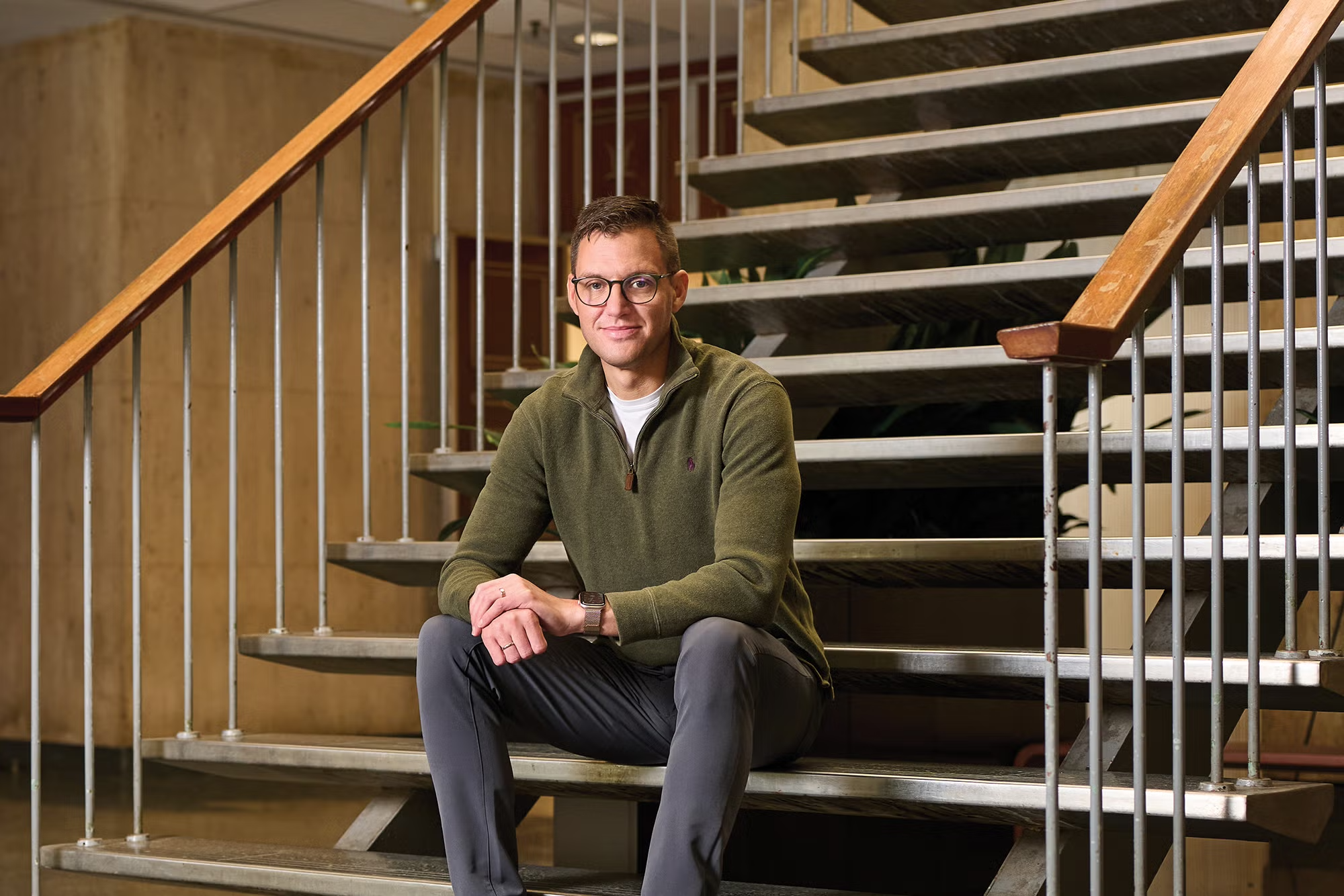
Kostadin Kushlev, Ph.D.
PI of the Happy Tech Lab, Georgetown University, Washington, D.C.
Digital technology promised to make us more connected, informed, and productive. Dr. Kushlev studies its real costs to health and well-being, from the obvious to the ones we barely notice. His research spans social media and the rapid rise of AI and large language models (LLMs). At its center is digital well-being, including everyday questions such as whether a digital detox actually helps. He is an Associate Professor of Psychology at Georgetown University, where he directs the Happy Tech Lab.
He earned his Ph.D. from the University of British Columbia in 2015 and spent three years as a Postdoctoral Research Associate at the University of Virginia.
His research is supported by a $1.5 million R01 from the National Institute of Mental Health. As Principal Investigator, he leads a study of how social media exposure shapes adolescent mental health (2024 to 2028). He also directs a McCourt Tech and Public Policy Program project on the costs and benefits of social media legislation (2025 to 2026). Earlier, he was a scientific collaborator on Greater Good in Action 2.0, a John Templeton Foundation initiative led by Dacher Keltner. His distinctions include Georgetown's Dean's Excellence in Teaching Award (2026), Fellowship in the Society of Experimental Social Psychology (2023), an APS Rising Star award (2021), and a $150,000 Vanier Graduate Scholarship that funded his doctoral training. He was elected to Phi Beta Kappa as an undergraduate at Reed College. A full record is on his CV.
His theoretical work appears in Psychological Bulletin, Current Directions in Psychological Science, and Current Opinion in Psychology. His empirical work appears in Psychological Science, Emotion, Journal of Experimental Social Psychology, and Social Psychological and Personality Science. All of his papers are here.
Dr. Kushlev has written for The New York Times, The Conversation, and Psychology Today. His research has been covered by The Economist, BBC, NPR, Forbes, Fast Company, Time, The Wall Street Journal, National Geographic, and The Washington Post. A full list of media coverage can be found here.
He advises ExpiWell, a mobile platform for running studies with the Experience Sampling Method. He is also a participating researcher with the Research-to-Policy Collaboration, a non-partisan effort to connect researchers with policymakers and strengthen evidence-based policy.
GRANTS
Causal Effects of Exposure to Social Media on Adolescent Mental Health. R01, National Institute of Mental Health. Role: PI. Total Awarded: $1,529,894. 2024 – 2028
Assessing the Costs and Benefits of Social Media Legislation. McCourt Tech & Public Policy Program. Role: PI. Total Awarded: $235,678. 2025 – 2026
Greater Good in Action 2.0: Making the science of character virtue more practical, engaging, and impactful. John Templeton Foundation. PI: Dacher Keltner, Role: Scientific Collaborator. Total Awarded: $1,778,612 (Awarded to Dr. Kushlev: $66,699). 2020 – 2023
SELECTED DISTINCTIONS
Magis Prize ($100,000), Georgetown University 2026
Dean’s Excellence in Teaching Award, Georgetown University 2026
Fellowship, Society of Experimental Social Psychology 2023
APS Rising star, Association for Psychological Science 2021
Vanier Graduate Scholarship ($150,000), University of British Columbia 2012-2015
Phi Beta Kappa, Reed College 2008
Click here for a full list of distinctions and scholarships
EDUCATION

Postdoctoral Research Associate, 2015–2018
University of Virginia
Advisors: Ed Diener, Shige Oishi

PhD Psychology, 2015
UNIVERSITY OF BRITISH COLUMBIA
Advisors: Dr. Elizabeth Dunn; Dr. Toni Schmader

BA Psychology, 2008